Economic Policy Council's background report: Higher wages in Helsinki reflect productivity
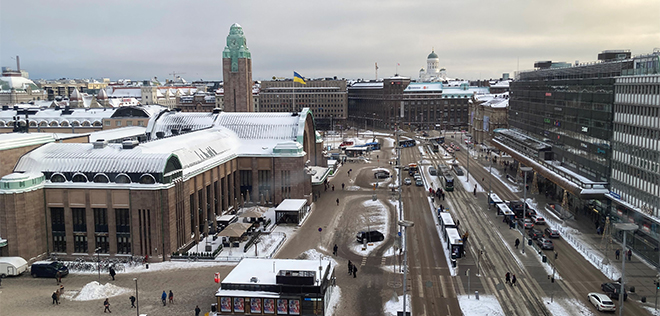
According to a recent background report by the Economic Policy Council, wages in the Helsinki travel-to-work area are significantly higher than in other parts of Finland. Work experience gained in Helsinki also leads to faster wage growth compared to other regions. The report attributes this to the higher productivity enabled by the larger city size, which enables higher wages.
In the background report, senior researcher Cristina Bratu and associate research professor Teemu Lyytikäinen from the VATT Institute for Economic Research, analyzed wage disparities in the private sector between different travel-to-work areas in Finland using comprehensive population-wide administrative data from 2005–2019. The study finds that doubling the number of jobs in a travel-to-work area is associated with a wage increase of over two percent.
"Our research provides precise and reliable evidence on the relationship between city size, wages, and productivity in Finland. The results suggest that also in Finland, the productivity of firms and workers increases with city size, and this is reflected in higher wages," says associate research professor Teemu Lyytikäinen from VATT.
The urban wage premium in Helsinki is substantially higher compared to other major cities
The study compares wages in the Helsinki travel-to-work area with those in Tampere and Turku, regional centers, and smaller cities. It finds that private-sector workers in Helsinki earn over seven percent more than workers with similar education, work experience, and job profiles in smaller go-to-work areas. The urban wage premium in Tampere and Turku is much smaller, at only one percent.
Work experience gained in Helsinki also leads to faster wage growth compared to other areas. A year of work experience in Helsinki increases wages by around two percent more than a year of experience working in other areas. Furthermore, this experience remains valuable when workers relocate to other regions, resulting in higher wages.
"Numerous studies have shown that wages depend on the size and density of urban areas, even after accounting for differences in worker characteristics across regions. In Helsinki, this urban wage premium aligns with wage disparities observed between the capital and other regions in other Nordic countries", notes senior researcher Cristina Bratu, from VATT.
Higher productivity enables urban wage premiums
The study reveals significant wage disparities between different regions in Finland. Based on economic literature, the concentration of jobs in large cities generates agglomeration economies, improving productivity. For example, in larger and denser labor markets, it is easier for workers to find jobs that match their skills, enhancing both individual and firm productivity. These productivity gains enable the higher wage levels observed in large cities. Without these benefits, firms would relocate to lower-wage areas.
"The results indicate that the clustering of jobs and workers in larger, denser cities can boost overall productivity and economic growth. Policy measures leading to the relocation of jobs and workers can generate economic growth, but the impact of such policies on regional equity and well-being should also be considered", says Teemu Lyytikäinen.
The urban wage premium is greater for women than for men
The study also examines wage disparities separately for men and women as well as by educational background. For women, doubling the number of jobs in a travel-to-work area increases wages by an average of three percent, which is slightly more than for men. The urban wage premium in Helsinki is also slightly higher for women: women working in the private sector with similar education and job profiles earn over nine percent more in Helsinki compared than in smaller travel-to-work areas.
Reliable estimates of urban wage premiums
The study uses comprehensive population-level data from 2005–2019 and focuses on private-sector regional wage disparities. When measuring wage differences between travel-to-work areas, regional differences in worker characteristics —such as education, experience, occupation, and employer sector—are controlled for. Furthermore, the study analyzes how wages change when workers move between regions. This approach enables the researcher to separate the impact of the region on wages from other possible factors more reliably than by comparing average wages across regions.
Report:
Cristina Bratu and Teemu Lyytikäinen (2024) The Urban Wage Premium in Finland. Memorandum 2/2024. The Finnish Economic Policy Council.
More information:
Teemu Lyytikäinen
Associate Research Professor, VATT Institute for Economic Research
Tel. +358 295 519 431
[email protected]
Cristina Bratu
Senior researcher, VATT Institute for Economic Research
Tel. +358 295 519 502
[email protected]
Cristina Bratu
Teemu Lyytikäinen
Finnish Economic Policy Council
Income distribution and inequality
Labour markets
Labour markets and education
Local public finance and provision of public services
Municipalities and wellbeing services counties
Press release
Uutiset ja tiedotteet
employer-employee matching
labour markets
municipalities and wellbeing services counties
pay gap
regional policy
work